How to Explain Agentic AI: The Ultimate Guide for Business Leaders & Tech Enthusiasts
Unlock the future of automation. Discover how Agentic AI transforms complex tasks into autonomous workflows—and why it’s the next big leap after Generative AI.
What is Agentic AI? Beyond Chatbots and Content Creation
Forget static chatbots and one-off content generators. Agentic AI represents the next evolutionary stage in artificial intelligence: systems that don’t just respond—they act. They perceive, plan, execute, adapt, and even collaborate—all with minimal human intervention.
Think of it as an AI employee: not just answering questions, but managing projects, coordinating teams (human or digital), troubleshooting failures, and making strategic decisions based on goals and context.
This isn’t science fiction. Companies are already deploying Agentic AI to automate customer service workflows, manage supply chains, conduct research, and even write and test code autonomously. It’s the engine behind the “AI-native” businesses of tomorrow.
The AI Evolution: From Data to Decisions to Autonomous Action
To truly grasp Agentic AI, you need to understand its place in the broader AI ecosystem. The image illustrates a clear progression—from foundational techniques to intelligent agents capable of full autonomy.
Let’s break it down layer by layer:
Layer 1: AI & ML — Turning Your Data Into Decisions
At the core lies traditional Artificial Intelligence and Machine Learning (AI & ML). This includes:
- Supervised & Unsupervised Learning: Training models on labeled or unlabeled data.
- Reinforcement Learning: Teaching systems to make optimal decisions through trial and error.
- Reasoning & Problem Solving: Logical inference engines and rule-based systems.
- Natural Language Processing (NLP): Understanding and generating human language.
Purpose: Extract insights, classify data, predict outcomes. Think recommendation engines, fraud detection, and basic chatbots.
Layer 2: Neural Networks — Detecting Complex Patterns

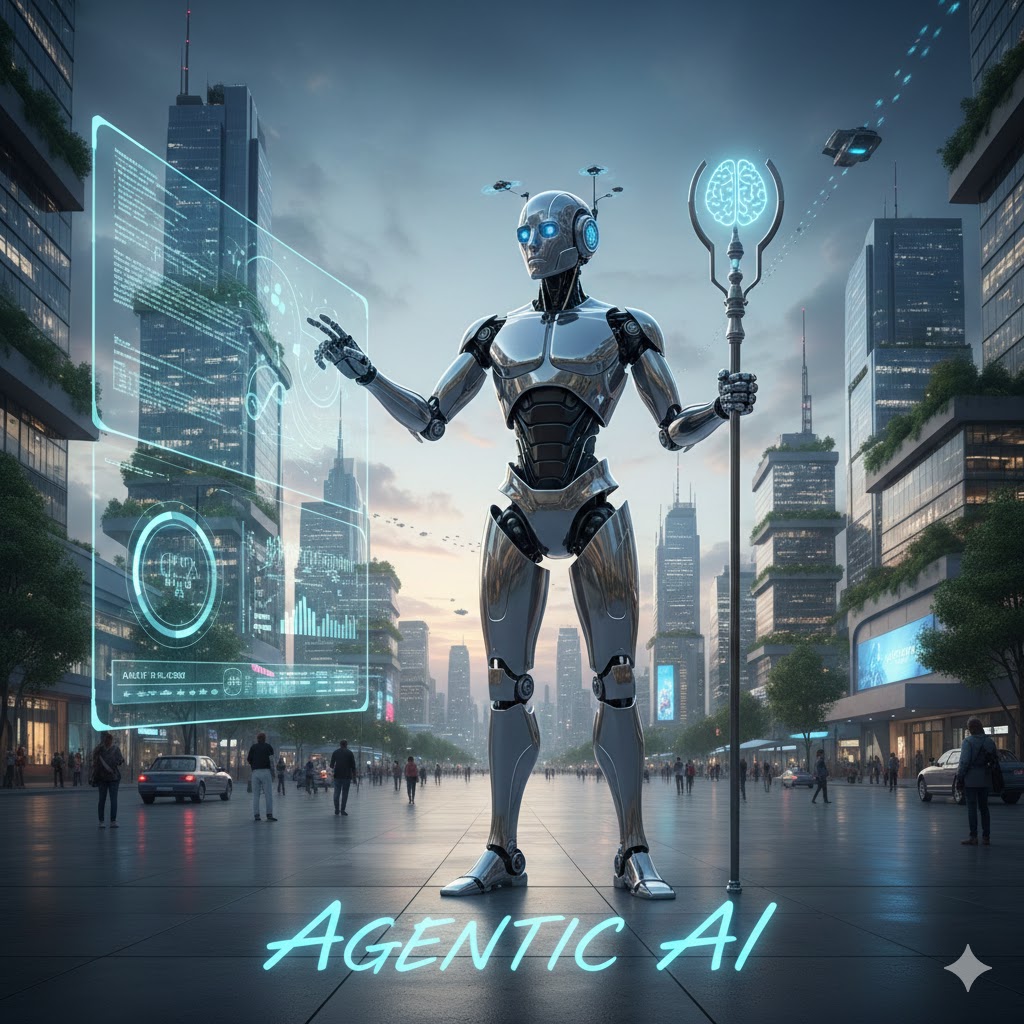
What is Agentic AI in Pakistan?
Building on AI/ML, Neural Networks enable machines to recognize intricate patterns in unstructured data:
- Convolutional Neural Networks (CNNs): For images and video.
- Recurrent Networks & LSTMs: For sequences like speech and text.
- Transformers: The backbone of modern large language models (LLMs).
Purpose: Power advanced perception—image recognition, speech-to-text, translation. This layer enables the “understanding” needed for higher-level reasoning.
Layer 3: Gen AI — Generating Content & Code at Scale
Generative AI (Gen AI) takes pattern recognition and turns it into creation:
- Large Language Models (LLMs): Like GPT, Claude, Gemini—generate text, summarize, translate.
- Multimodal Generation: Text ↔ Image ↔ Audio generation (e.g., DALL·E, Sora).
- Code Generation: Auto-generating software from natural language prompts.
- Speech Interfaces (TTS/ASR): Conversational interfaces powered by voice.
Purpose: Automate content creation, accelerate development, personalize user experiences. This is where AI becomes a creative partner.
Layer 4: AI Agents — Executing Complex Tasks Autonomously
Now we enter the realm of AI Agents. These aren’t just tools—they’re goal-oriented entities:
- Tool Use & Function Calling: Interacting with APIs, databases, and external software.
- Planning & Goal Decomposition: Breaking down high-level objectives into actionable steps.
- Memory Systems: Storing short-term context and long-term history.
- Human-in-the-Loop Oversight: Allowing humans to intervene or validate outputs.
- Self-reflection & Error Recovery: Learning from mistakes and adapting behavior.
Purpose: Execute multi-step workflows without constant supervision. Examples: An agent that books travel, researches market trends, or debugs code.
Layer 5: Agentic AI — Automating Entire Processes with AI
The outermost layer represents the pinnacle: Agentic AI. These are systems designed to operate with long-term autonomy, manage resources, and coordinate with other agents:
- Multi-agent Collaboration: Teams of AI agents working together (e.g., one researches, one writes, one validates).
- Agent Coordination & Communication: Protocols for agents to share state and delegate tasks.
- Long-term Autonomy & Goal Chaining: Pursuing complex, evolving objectives over time.
- Governance, Safety & Guardrails: Ensuring ethical, safe, and compliant behavior.
- Dynamic Tooling & Failure Recovery: Adapting tools and strategies when plans fail.
Purpose: Automate entire business processes end-to-end—from sales pipeline management to R&D to customer success—with minimal human oversight.
Why Agentic AI Matters Now: The Business Imperative
We’re entering an era where competitive advantage will be defined not by who has the best AI model, but by who can deploy the most effective autonomous agents.
Here’s why:
✅ Scalability: Deploy hundreds of agents to handle routine tasks, freeing up human talent for strategy and innovation.
✅ Efficiency: Reduce cycle times by automating multi-step, cross-functional workflows (e.g., contract negotiation, customer onboarding).
✅ Resilience: Agents can self-correct, retry failed steps, and adapt to changing conditions—unlike rigid scripts or manual processes.
✅ Innovation Acceleration: Rapid prototyping, automated research, and iterative experimentation become possible at scale.
✅ Cost Optimization: Lower operational costs through automation while maintaining—or even improving—quality and consistency.
Causal Analysis: What Drives the Rise of Agentic AI?
The emergence of Agentic AI isn’t accidental. It’s the result of several converging technological, economic, and organizational forces:
1. Technological Maturation
- Advances in LLMs have made sophisticated reasoning and planning feasible.
- Better memory architectures allow agents to retain context across sessions.
- Improved tooling frameworks (like LangChain, AutoGen) simplify agent orchestration.
Causal Link: Better models + better infrastructure → More capable agents.
2. Demand for Operational Efficiency
Businesses face pressure to do more with less. Manual workflows are slow, error-prone, and expensive.
Causal Link: Rising labor costs + complexity → Need for autonomous execution → Demand for Agentic AI.
3. Shift from Task Automation to Process Automation
Early AI focused on single tasks (e.g., “summarize this email”). Now, enterprises want to automate entire processes (e.g., “manage this client account from onboarding to renewal”).
Causal Link: Limitations of siloed automation → Demand for end-to-end workflow automation → Rise of agentic systems.
4. Improved Safety & Governance Tools
Concerns about hallucinations, bias, and misuse have slowed adoption. But new guardrails—feedback loops, observability, rollback mechanisms—are making Agentic AI safer and more trustworthy.
Causal Link: Risk mitigation → Increased confidence → Wider deployment.
5. Economic Incentive for Long-Term Autonomy
Organizations want systems that learn, adapt, and improve over time—not just follow static rules.
Causal Link: Desire for continuous improvement → Investment in self-improving agents → Growth of Agentic AI ecosystems.
Summary: The Agentic AI Revolution Is Here
The image clearly maps out the evolution of AI—from foundational machine learning to fully autonomous, goal-driven agents. Agentic AI is not just another buzzword—it’s the logical next step in the automation journey.
It combines the power of generative models with the autonomy of intelligent agents to execute complex, multi-step processes with minimal human input. Whether you’re automating customer support, accelerating product development, or optimizing supply chains, Agentic AI offers unprecedented levels of efficiency, scalability, and resilience.
Ready to Embrace Agentic AI? Start Here
- Audit Your Workflows: Identify repetitive, multi-step processes ripe for automation.
- Start Small: Pilot an agent for a single use case (e.g., auto-generating reports or triaging support tickets).
- Invest in Governance: Implement safety checks, observability, and human oversight protocols.
- Build or Buy: Leverage platforms like Microsoft Copilot Studio, Google Agent Builder, or open-source frameworks like AutoGen.
- Upskill Your Team: Train employees to work alongside AI agents—not compete with them.
Final Thought: The Future Belongs to the Autonomous
As AI continues to evolve, the line between human and machine collaboration will blur. Agentic AI won’t replace people—it will empower them to focus on what matters most: creativity, strategy, and human connection.
The organizations that master this transition will lead the next decade. Don’t wait. Start building your agentic future today.
Keywords for SEO: Agentic AI, AI Agents, Generative AI, Autonomous AI, AI Automation, Multi-Agent Systems, AI Workflow Automation, AI for Business, Large Language Models, AI Strategy, AI Governance, AI Tools, Future of AI, AI Trends 2025, AI Implementation
Published: Saturday, December 06, 2025
Author: SkillPen muhammadrameezqaiser.com
Category: Artificial Intelligence, Business Technology, Digital Transformation
Read Time: 7 minutes